


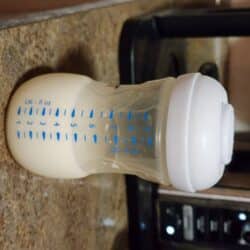




A new study by the Boston University School of Public Health shows that even when hospitals encorage new mothers to breastfeed, those same hospitals sometimes do things that increase the chance the babies will end up drinking formula instead. See entire article here.
Basically, trained maternity nurses who should have been taught “Breastfeeding 101″ at school are giving new babies bottles of formula when they feel mom needs a rest or they think that the baby needs “extra nutrition.” Yes, giving birth can be exhausting, but most moms can manage to nurse around rest times, and if they can’t then there should be someone there to hold the baby at mom’s breast. As far as extra nutrition goes, the fact that the lead author of the study tells us that some new mothers “can’t produce enough breast milk for their baby’s nutritional needs” blows me away. Five percent of new moms can’t produce enough milk, and generally they only figure that out after the time comes when their milk should be coming in. So to me, the first few days don’t count. There should be no need to supplement.
When I had my first child in the hospital I was delighted to see a row of little baby food jars in the nursery showing parents just how milk colostrum or breastmilk their baby would be drinking over the coming week. Day one: hardly any, day two and three, only a little bit more. Days four through seven saw the jars fill up, but keep in mind they were baby food jars so it still wasn’t a lot. What an easy way to educate someone, without having to say a word! A hospital is a place of education, and when a new parent sees a medical professional doing something, they are going to assume, often without question, that it is the “right” thing to do, or at least that it is not going to be harmful. But supplementing with formula is harmful, especially to moms who want to breastfeed exclusively and have that right taken away from them by “well meaning” medical staff. There should not be a need to feed a baby “extra nutrition” before his or her mom’s milk comes in. If there is an IBCLC or La Leche League leader out there who disagrees with this statement, please comment so I might stand corrected.
I’m absolutely appalled that ignorance around breastfeeding is still so rampant among the leaders in the health care system, be they nurses, doctors, and/or scientists! It should be common knowledge that a mother’s breasts produce colostrum for the first few days before her milk comes in. Milk “coming in” is when the yellow drips of liquid coming out of your breasts upon your child’s birth, turns into a flood of creamy white milk. For some moms, it takes even longer for milk to come is as Mommy News and Views shares with us a correspondence with one of her readers.
After reading this article I feel like calling up all the nursing and physician schools and demanding that they devote time to and properly train their students in breastfeeding practices. And where is the continuing medical education for the seasoned professionals? If it’s here why aren’t they taking it? It’s not acceptable that maternity ward health professionals are still in the dark about breastfeeding best practice. All it would take is these care providers following best practices and I think breastfeeding stats would rise substantially.
What do you think? Please share your views by leaving a comment. And if you liked this post please consider subscribing by RSS or email.
Related posts:
- Monday Musings: The Root Of The Mommy Breastfeeding Wars
- Monday Musings: How Strict Are You About What You Put In Your Body When Breastfeeding?
- Monday Musings: Why Do So Many Women Living in Poverty Not Breastfeed??
- Monday Musings: Getting Paid To Breastfeed
- The Princess And The Chick Pea (And The Grape And The Walnut)
Tags: bottle feeding, breast milk, breastfeeding rates, colostrum, formula, hospitals, IBCLC, nurses
Posted by Breastfeeding General, Breastfeeding Infants, Children's Health, Health Care System, Pregnancy & Birth Subscribe to RSS feed


[...] Monday Musings: The Problem With Ignorance | Breastfeeding Moms Unite [...]
Great post! I was the *only* mother in the maternity ward who even TRIED to breastfeed my daughter “around the clock.” But because of continued pressure from the nurses to send my daughter to the nursery–not to mention interruptions for blood pressure tests, etc. at that point JUST when my daughter and I had BOTH finally fallen asleep–I finally gave in and said, “Take her.” I felt sick to my stomach over the decision, knowing intuitively it was wrong, and went back to the nursery three times debating if I should take her back or not.
Finally, when a nurse woke me after I left my daughter in the nursery so I could sleep, I literally STORMED into the nursery and said, “[profanity here] Give her back to me if you’re not going to let me [profanity] sleep anyway!” LOL
That was my hospital breastfeeding experience. Next time, I want to be sent home almost immediately after birth. And I will be telling the nurses what’s best for me, not the other way around. (I’m one of those problem patients.)
Sorry, you hit a nerve! But THANK YOU for sharing this story.
I couldn’t agree more.
Amen, amen, amen! I am a LLL Leader, and we periodically have health care professionals attend our meetings to observe. They have shared with us how overwhelming they have found it to try to teach new moms to breastfeed, when they’ve never done it and know little about it themselves. Health care professionals who are caring for new moms and babies need to have a good understanding of how breastfeeding works. I know that there are initiatives to improve things, which is great, but why has it taken this long?
Amber’s last blog post..The Case Against Breast-Feeding
I was told to feed my baby only every three hours while in the hospital. When he was wanting to be fed before the three hours was up the midwife said he was clearly not getting enough milk and needed a top-up of formula. When I said I’d rather she didn’t, the paediatrician was summoned to explain that babies don’t get enough calories from colustrum and top-ups would satisfy my hungry baby. I had to give him a feed and then summon the midwife who forced a cup of formula into his mouth (despite him clearly fighting it because he was full and sleepy). When she had emptied her cup, my darling son promptly belched like a trucker and threw it back up all over her!!
I am continually impressed by the competence of some maternity nurses/pediatricians and alternately horrified by the incompetence of others. I do think that the “don’t make me do something I don’t want to do” mentality has filtered to that profession though. It seems like the professionals I have run across waited until I said I was willing to feed on demand, etc, to agree with me and encourage me.
When my first child was born, in a very large hospital (third largest maternity ward in the country), my child was given glucose water before I even had a chance to nurse him the first time. And when he was in the nursery one night, even though I had instructed the nurses to only give him a 1/2 ounce of formula (b/c of the pediatricians instructions), he was given a full three ounce bottle!!!! At one day old!
Ack. Well, in spite of those issues, we did go on to have a good nursing relationship until just before his second birthday, though he was supplemented the whole time.
My second child was born just two months ago. He needed a bit of supplementing (my milk comes in late, and the babies who are born big, tend to lose a lot of weight and everyone freaks out) at the beginning, but I had some pumped milk from a friend of mine so he only ever got about five ounces of formula, ever. Also interesting, I was never offered formula at the hospital this time. And, the pediatrician who discharged the baby was incredibly supporting of exclusive breastfeeding, even in the face of jaundice. And he was pretty old school (and nearly 70 years old) so I don’t buy it that people can’t be educated. He was the exception in that he VOLUNTEERED the information, without me asking. I am now able to nurse exclusively, but it has been a huge effort on my part, but if I had relied just on the professionals in the hospital and doctor’s office, I don’t know that I would have.
I think one of the main stumbling blocks for the medical professionals, especially when dealing with newborns who have any medical issues, is the fear of litigation. There are a few situations where supplementing is necessary, but if they push EBF, and there is a problem with the baby, they could be sued. No doctor is going to be sued for supplementing a baby with formula, but they might be if the baby is failing to thrive and formula was never offered.
It is a bit of a conundrum.
Kimberly’s last blog post..Parenting choices…can we judge?
I feel for the nurses too when faced with a teary and emotional new mom..staring at this small creature that won’t stop crying and we don’t know what to do and we are so tired…I really think the nurses are trying to just help half the time..to give the new mom some peace.
I mean..we are told our milk will take a while to come and the colostrum will do…but if we can’t comfort our new baby who we feel so much responsibility for…it can be cold comfort.
And yeah..a mat ward is really not the most restful place to get into the newborn groove.
crunchy’s last blog post..Kalloo Kallay!!! Spring Break is Almost Over!!!!
Great article – but I wonder how much better the breastfeeding rates would be if ALL hospitals were Baby Friendly accredited? I work as a midwife in Australia – in a public hospital that IS BFHI accredited and I am appalled at how many birthing women would choose a hospital because of the wine with dinner – OVER their breastfeeding rates. I also think that midwives need to change their thinking – yes mothers need their rest – but a baby with a full tummy – ie breastfeed – and a cuddle from mum WILL sleep in the first few days – I think health professionals are quick to jump in when a baby hasn’t read the *rule* book.
@AmberI too have attended LLL meetings where nurses-in-training attended. When I asked them why they didn’t get this stuff covered in the classroom they said the instructors didn’t have time! Shows you how important they consider breastfeeding to be hey? So instead they let the leaders “teach” them. Might be a good start but bf’ing101 needs to be taught in the classroom!
@Kimberly – the litigation is something I didn’t think about, but I believe you are right. However, if we can make basic breastfeeding knowledge and practice standard across the board for medical staff and the public then worries about suing shouldn’t be such a big problem. But maybe I am being too naive….
@mum2abc – I love the midwife input. Thank you!
@crunchy – Nurses need to be able to make the mom feel better about the trying times in the early days by normalizing them. I think new moms feel like they are failing when baby doesn’t latch right away or has problems feeding. But if we knew that most of our peers are having the same issues that peace of mind might help repair our insecurities right there.
@Dawn and PrettySprinkles – thank you for sharing your stories
Melodie’s last blog post..Poll Results: Moms Who Don’t Cover Do Breastfeed Longer
[...] In my opinion, this is why moms have the breastfeeding problems in hospitals that they do. See Monday Musings: How Hospitals Contribute to Lower Breastfeeding Rates. If you have a problem with breastfeeding, the first people you should contact for the most [...]
I’m lucky that the hospital didn’t ruin breast-feeding for me. I had a c-section and didn’t get to see my daughter for 4 hours!! My (clueless) husband allowed them to give her some formula to “warm” her up since they had let her get too cold. I gave her some more fomula after a nurse told me she was still hungry. I knew how small her stomach was (it was even on the wall) but I was so tired and I just needed to sleep so I did. Thankfully that was all the formula she ever got.
Also instead of helping me latch properly they gave me a nipple shield which I then had to use for months.
Kelly’s last blog post..Wordless Wednesday
i felt that the hospital i gave birth at was two-faced. sure they had a lactation center and lactation consultants but i didn’t feel that they provided good support. the nurses were uninformed – one nurse told me that pacifier use was ok – no issues with nipple confusion AT ALL (that nipple confusion was just because of paranoid parents) and when we were discharged, we got an ENFAMIL hospital bag with free samples.
later on, when I was having trouble with the latch and rented a pump, the lactation consultant at the hospital subtlely sold me a wrap that i didn’t really need (this wrap was used 2x) by telling me that to successfully breastfeed, i needed to put the baby in the wrap constantly. i just felt that the hospital’s consultants had a one-size-fits-all solution to breastfeeding issues and didn’t even attempt to listen to the actual problems each individual moms had.
it also did not help that during the free breastfeeding support group meeting in the hospital (my daughter was about 5 days old then), there were a couple of moms with older babies (6mos, 10mos) who where saying their babies were never as small as my baby.
Jenny’s last blog post..A Nursing Mom’s Shopping Guide in Manila – Nursing Bras
Thanks for pointing me to this post. Maternity nurses should be required to take breast feeding training. Especially considering all of the studies that show breast fed babies have less ear infections, respiratory distress, etc. It helps the healthcare system over all when babies are healthy. And, that starts with breast milk – not formula.
My milk didn’t come in until the morning of day 6! Thank God I didn’t give birth in a hospital or my baby would have gotten formula. I consulted a lactation consultant. But only after I had used my breast pump to stimulate my supply. And boy did it ever! It taught me about supply and demand b/c I ended up making too much. It eventually leveled off once I stopped pumping for a while.
Have you posted about nursing strikes? My baby went on one at 4 months of age for no apparent reason. I had some pumped milk frozen for my mom to feed him so my husband and I could go out. I ended up using all of it and resorted to 2 days of formula. – but very small bottles – as I was working with a lactation consultant. I cringe whenever I see a mom with an 8oz bottle and a newborn flat on his/her back being “force fed” all that formula. Who tells these moms to give them that much?
At the end of 4 days I tried different positions and let my stress go and he finally latched on again and resumed nursing. I was so stressed thinking our nursing relationship had ended. I was heart broken. Thankfully a friend of mine who doesn’t have a child said “maybe he’s just not hungry right now”. And I relaxed and looked at him differently – like a human being who may want more on one day and less on another – like us. Who may want to sleep 12 hours one day and 10 the next. I had it in my mind that they need to nurse 12 x in a 24 hour period and then 8-10 in the same time period, etc. I was being so rigid. When I let go, he came back!
Pure Mothers’s last blog post..Plastic Packaging Awareness
[...] problems down the road, monitor our progress, give encouragement, etc. The problem is, it’s the hospital-based health care professionals who are contributing to lower breastfeeding rates in our [...]
[...] fellow citizens for awhile, but then I surf off onto twitter or some news sites, and I read about hospitals contributing to lower breastfeeding rates, formula companies sponsoring health conferences, moms getting kicked out of pools and off buses, [...]