







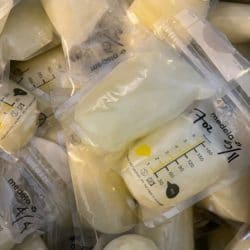
Oblivious to the favourable or non-favourable conditions of my womb.
There are some findings from a new study going around that claims breast milk is not vital for an infant’s optimum health. According to Professor Sven Carlsen, the leader of the Norweigan team of scientists who conducted the study, the conditions of the mother’s womb, specifically the balance of hormones, is a more important variable for a child’s long term health. Women’s androgen levels increase during pregnancy. This is the hormone that dries up a nursing mother’s milk supply. He found that if the level of androgens in the mother’s womb is too high then the flow of nutrients from the placenta to the fetus is negatively affected. These same hormones later affect the mother’s ability to breastfeed, resulting in a misleading assumption that the lack of breastfeeding is what causes any health problems. He takes the stance that whether a mom breastfeeds or bottle feeds is of no significant difference – the damage, if any, has already been done. He argues that breastfed babies are generally healthier because the conditions in their mother’s wombs are more favourable.
Luckily, for us lactivists, his study is being met with plenty of doubt. My take is this: If hormone imbalances are the problem for children whose mothers can’t breastfeed, then this condition could explain the problems of the very few women who cannot actually produce a sufficient milk supply, excluding of course, those who’s supply issues are a product of breast surgery, postpartum hemorrhage, insufficient glandular tissue, prolonged severe engorgement, retained placenta, low thyroid, pituitary problems or other endocrine problems [Source: La Leche League]. But it wouldn’t explain those mothers who persevere through their breastfeeding problems and go on to successfully breastfeed, even though they were told they couldn’t, and who have healthy children.
A small percentage of women truly cannot produce enough milk, but it is only 2 to 5 %. Did the results of this study show that this percentage of mothers could blame the reason for not feeding on high androgen levels? I didn’t see that. Of course more women than that quit breastfeeding before or after 6 weeks, 3 months or 6 months, as was measured. But women stop nursing or don’t nurse for a myriad of reasons unrelated to physical problems – return to work, lack of support, lack of knowledge, cultural reasons – none of which he appears to have measured. And women persevere and nurse even when obstacles are mounted against them. For the women who stopped breastfeeding early, did he take into account any non-endocrine reasons? Like improper latch, nipple pain, or infant lethargy?
This study is one more dangerous piece of research telling moms that formula is just as good as breast milk if you don’t want to or can’t breastfeed. And sure, it is okay if a mom needs to use formula or chooses to use formula, but there are countless other studies out there that express the opposite of Professor Carlsen’s findings, and we need to remember those. One study does not all other studies crush. Formula is not just as good. Some women can eventually produce milk for their babies. High levels of androgen are only one reason a woman may have breastfeeding problems. And the quality of a baby’s overall health is dependant on so many different factors it would be impossible to account for all of them. Perhaps hormone levels really do account for some future health outcomes but I can’t accept (nor should anyone) that this is a blanket reason for all infant health issues. Did the scientists account for environmental contaminants such as air quality? Genetic factors? What about postpartum stress? Maybe the mother’s stress of not being able to breastfeed causes health problems for babies. Infants are known to be highly sensitive to maternal stress. There are too many holes in this study to be taken too seriously or to freak out about. So in my opinion, don’t.
Related posts:
- Not So Astonishing to Want to Breastfeed Octuplets
- Breastfeed For Earth Day!
- Monday Musings: Why Do So Many Women Living in Poverty Not Breastfeed??
- Monday Musings: How Hospitals Contribute to Lower Breastfeeding Rates
- Self-Attachment: Smart Babies Want to Breastfeed
Tags: androgen, formula, hormone levels, La Leche League, latch, milk supply, nipple pain


AMEN! you said all that I wanted to say, but more eloquently
Aw – thanks for the linky love. That stupid article! That’s all the breast-haters need to feel superior and spread false information. Grrr.
TheFeministBreeder´s last blog ..Introducing TFB’s Radio Show/Podcast
I hate it when a new study is published and the most simplistic possible spin is put on it, then it’s taken as fact. This is SO not limited to this study, or to breastfeeding studies. It’s more a symptom of the way that news is handled.
I’m with you, this is ONE study. While it raises an interesting theory, it’s hardly conclusive on its own. So I’m not going to put much credence into it, at least not now.
Amber´s last blog ..Figuring Out What You Want
I read the study. I don’t get how a small study, with 181 women in total, most of them breastfeeding, that suggested that high androgen levels in pregnancy may correlate to quitting breastfeeding at 3 months, can conclude- that formula is just as good as breast milk. The study didn’t look at formla of fed babies compared to breastfed babies. I don’t see how this study, with 181 women in it, looking at the levels of hormones, can mean “breast is not best”, and I think reporters who are calling it this way are being irresponsible.
I can’t believe how many people have retweeted the link to an article about this study. How many new mothers have read that stupid article and thought, great, now I can bottle feed and know my baby will be just as healthy as if I breastfed. How many people who lapped up that article and retweeted it actually went back to the study and looked at with a critical scientific eye? Grrrr is what I have to say right now. Thanks for taking it on.
Julie´s last blog ..New year, new resolve
I was really sad when I read that article in my newsfeed. I’m much more affected now as my sister is currently in preterm labor at 32.5 weeks. I’ve been encouraging her to breastfeed ever since and I hope she will do so even more now that her baby will be a preemie.
Jenny´s last blog ..Breastfeeding Classes Tomorrow
ugg! Things get so simplistic!
Naomi´s last blog ..House Gloom
@Pat @Julie – I’m pretty sure his statement must have been funded by a formula company. Because any good scientist wouldn’t make a sweeping statement like that, when you’re right, his conclusions have nothing to do with formula being better or just as good as, without getting something for it.
Thanks for writing this Melodie.. I’m sad about all the hoopla and attention this study got on Twitter and probably other sites where unsuspecting pregnant or nursing women are negatively influenced about bfing. As Amber said above, this is ONE study and I agree that although interesting, it doesn’t carry much proof at all for me. I like this collection of data by the US Dept HHS current as of May 2009: http://www.ahrq.gov/Clinic/tp/brfouttp.htm … where they looked at some 9000 studies!
I also value Marsha Walker’s words “ABM [artificial baby milk] does NOT duplicate the complexity, CANNOT provide the multiple tiers of disease protection, and CANNOT operate in the dynamic manner of human milk! ABM simply fulfills the role of maintaining growth and development within normal limits.”
I bet she’ll have a comment about this study and I’ll pass it on to you when I see it.
StorkStories´s last blog ..For Expectant Families… your “Due Date”…